Friday, November 12, 2010

Of lab reports, melancholy and sheer boredom

 
NOTE: This blog is intentionally condensed. If you cant take it, you might consider some lighter reading below.


In all honesty I am perplexed by my sudden influx in the interest to blog. I suppose it’s a therapeutic after all the lab report writing and trauma that follow the beginning of winter. A note of interest would be that the idea of this blog was conceived while my mind roamed deep inside the art of creating tables for Viscosity Lab, ENG 191. The work was tedious but let me crystallize an unshapely and ungainly spark into an idea of substance.
The idea centers the quintessential question; can engineers, masters of technology contribute meaningfully to research in the pure sciences. What is the role of the overbearing “lab report” in attaining this end. At first it might appear ludicrous to the point of lunacy to connect these two points which seem at far ends of an n dimensional Einsteinium space. As I continue I shall demonstrate how related they are in as concise a manner a good, prosaic engineer can deliver.
  •   Lab reports create an understanding of how science really works. It goes beyond the equations of physics and the theories of chemistry into the real crux of an experiment. I was perturbed when I found out that despite the same type of material and density, the different tubes exhibited different viscosity.
  •    Lab reports create a respect for the powers we seek to control. I would never have imagined that Physics, i.e Young’s modulus would have made me skip a few suppers; some sleep and hypnotically control my brain for a full three days.
  •   Lab reports demonstrate how much we still have to learn in the sciences. (Refer Viscosity lab write-up Page 5-8. The formulas look like they involve tensors{hyperbolic})
  •   Lab reports give us an insight into how intricate, arduous and in other words, absorbing and interesting different sciences can be.
  • Lab reports are a necessary pain in the arse, but once completed, they can be looked on as a finished work of art. I know for a fact that when I hold all those sheaves of printed paper in my hand, I probably feel as proud as Albert holding his 1905 paper on special relativity.

So, to get an understanding on how we engineers differ from our nerdy scientist brethren I need and can think of one obvious reason. Unlike “them” we use the different sciences to create meaningful articles for use by people and industry. We are the medium by which lots of folk back home wash their laundry (washing machine) or look up shows beamed from halfway across the world (satellites, tv sets). Yet I must remember that all these are but possible because of people who chose to research on the fields of sciences like Math, Physics or Chemistry. These people are not too different from us either. They just have a more disproportionate distribution of passion across subjects. Engineers with their ability to connect science with good use for the benefit of mankind are natural partners in any scientific research. 


Astrophysics and dark matter holds a special romantic space in my heart usually reserved for people I love. In time they will surely provide mankind with some tangible benefits. Can’t an engineer research on this frontier of space? Or will over-specialization eat up all chances of a multidisciplinary search for truth. With all the wisdom from the lab reports, how can we go wrong?


Thursday, November 11, 2010

Grasping the notion of being American.

Affirmation-Savage Garden


I am a student of the Ohio State University in Columbus OH, Midwest region of the United States of America. I am a student in one of the largest university in this country. I am an international student in a foreign land. In this blog I will write about how I try to make, this New World my home.
There are no true ways to measure people. No arbitrary generalization or stereotype can serve as an absolute definition of a society, not the least in diverse America. So to get a feeling of this place I needed to understand my own feeling and analyze my experiences. So through my story at OSU, I try to bring out what my new home, truly means.

I am an engineering major and this makes most of my classes Science or Math based. Additionally as an honors student I end up meeting most of the smarter people in the college. The classes are liberal and the students self dependent. So, one stereotype of Americans as being fiercely individualistic is proved to an extent to be true. It is almost as if no one wants to know much about anyone else s business. This might be in a way good, but I fail to see how ever competition might arise if no one seeks out rivals. The best answer I can offer myself is that they compete with themselves and use averages or numbers as targets. Sounds weird but this is the norm of a new world.   


Then again the society is as dynamic as the American stock market and this justifies the saying, “only in America”. From college students pioneering research to underage binge drinkers who completely lose control, the college society is plagued and yet gifted by some of the most vicious and virtuous traits. This mess can only be characterized as sardonic or regretfully amusing by an outsider. The conflict is caused by less of an issue of lose morale and more of the need to keep an external prudish image. For all the fun they strive to have, college kids strive equally hard to maintain a crisp image that might be diametrically opposite to their character.  


Cultural differences to what I am used to is abundant. Relationships for starters are treated much more carefully and if I care to add ‘properly’. Unlike the laissez faire I was used to for most of my life, America where everything seems to go, also has some unsaid rules of its own. Learning the ropes have been hard, painful even and managing the complexities of relationships challenging. For what can be considered proper or even apt somewhere else in the world, can and is probably considered weird on this side of the planet. So as I feel my way through this intricate but gossamer web of society I hope to come out at worst with a bruised eye and a broken heart. Nothing too permanent I hope. At worst I could always do what the French do; Parley! 

Friday, November 5, 2010

Friends I knew


Let me post something a little more personal for once. This post was long in the making. That’s because it has touched me the most and deals with something close to my heart. It deals with several of my closest friends. I see them as part of my family. They changed me and they taught me things I might never have learnt.

We make lots of friends in our lives. Each time we meet someone new, we can’t help ourselves but try to understand them. There is something in us, as humans that make us wonder and wish to meet people of our kind. Even the Spanish conquistador, Cortes tried to understand the Incas before he vanquished them and their empire. In a country as diverse as India I meet tons of different, yet similar people. They are different because they come from different backgrounds, communities, regions and religions but they all share a common culture and understanding. Yet there are often so many misunderstandings within my country. Imagine an Indian who goes to an international forum. He must be a public menace, right?


This is probably true of other large countries. On the October of 2009, I was lucky enough to take part in the World School Forum, Japan. I and two of my compatriots boarded the plane with different notions and ideas. We might deny it now, but I distinctly remembered worrying if the Australians would find us ok (there were lots of race riots in Oz back then). Now you can ask yourselves, why would we even want to bother to go through these programs? I’ll come to that at the end.

I reached my room in Tokyo at past midnight. I was sharing it with a kiwi, Chinese and Japanese. India fought a war against China, and the Japanese plus, I didn’t know much about New Zealand. Of course all this was the last thing on my mind back then. I got into my room awkwardly enough. Tomoki (my Japanese mate) insisted on carrying my bags. I tried to apologize to the guys for waking them up. I slid into bed.


The first day, we broke barriers. We sat with our own countries but during the first break, we broke ice. I guess we were so curious about the others that we just couldn’t control ourselves. We were super excited and that brought inhibitions crashing down. I chatted up with some South Africans who loved cricket, kindred spirits. I met some awesome Canadians; my Asian brothers from Korea, Japan and Indonesia. I spotted my neighbors from Sri Lanka and the second best debater of Romania. I found a Fin and we talked about Stalin and met a New Zealander who loved Japanese Manga. I also ran into a very crazy but intensely lovable Aussie. It was a wildly awesome day.

We learned many different things from each other. As the theme of the forum was food and value, we understood a lot about the food cultures of the different countries. That was not the end though. Anything from games to movies, sports and dances was talked about or (in case of dance) tried. So with every day we kind of grew closer and closer, till the final day when we didn’t want to leave each other.


So why did we do it? What’s the point of these forums and meets?

There is this one thing and it’s called diversity. Its importance is not often realized and most often misunderstood. Exposure to diversity allow us to see problems from a variety of perspectives. It lets us use the diverse knowledge of different people to solve common problems. Take for example Japan’s problem of an aeging population. India with its strong family value system faces the reverse problem of too many young people and over population. Perhaps both countries can learn from each other and obtain solutions to their respective crisis. Again, when you try to find a solution to cut global emissions you need a personalized method for every nation.


Another thing we learned or rather experienced was what you would call the appearance of the Globalism . We communicated effectively amongst ourselves because most of us spoke English. Those who did not understood the importance of this particular language. We had common interests in music, bands, clothing and some foods (The Italians won with their pizza and spaghetti). We even face the same problems of terrorism, pollution, environmental degradation and economic meltdown. This does not mean we were completely alike. Rather each of us added a different flavor to the forum that just made it sweeter.

The best thing was the most personal. It dealt with how each of us looked at the rest as outsiders and someone different. You realize how pointless it is to worry about meeting and mingling with people. Different races, customs, languages and cultures coexisted together and worked on the forum together. In our pursuit to fight problems and work towards common goals (even in the football game) we found that our best allies were ourselves.


We have learned that and we need to live that. We make choices that do not cause prejudices. We work to make other s understand this. And we never let the friendship die. While we are students we have got to work hard to get good grades, because when we grow up we have to meet again. Then we will do more.


Friday, August 20, 2010

Of Ohio State, Columbus and Chennai


I’m living a countdown. With every night I come one day closer to leaving for college. The college isn’t a hundred or even thousand miles away, but ten thousand; a different country. Right now the full enormity hasn’t sunk in. It’s exciting, fun even with the shopping and all, but its also a bit confusing. I don’t have many qualms about traveling or moving on. I have changed more schools than most people change cell phones during their entire lives. I’m a Hindu but I love chili (ground beef) just as any Texan or bacon as any English. I guess my problem comes more from the fear or uncertainty after leaving the country than anything else.


This time next month I’ll be in my dorm at Ohio State. I would have met more than a hundred new people. The prospects exciting but there are so many nuances that keep on bothering me. I’ll be taking an AT&T connection with a hi-fi LG Smart-phone, which apparently won’t have wireless. To get a wireless in the US I need to take a separate data plan, despite the fact that I can use the free wireless network on campus. Another thing is the way prices keep changing from one day to another; they just won’t keep still!
The good things are well obvious. Cheap food at good ol’ MacDonald’s and excellent infrastructure (high speed internet, transport the works). The people are obviously the biggest cause of worry. What are mid western Americans like? The internet tells me that they have the best of both east and west coasters but seeing is believing, right?


Finally there is the fear of a patriot that my feelings towards this country might change. I am a modernist and I favor Globalism over nationalism and yet as a person there can be but one home. India has lots to grow, a long way to go and lot of work to get there. I want to be a part of this journey, granted as I am a privileged position by birth. Maybe the beginning of a strong overture to globalism will be amongst co operation between nations like the United States and India. The research, innovation in the states can help the poor of India. India with its technical skill, large market and innovation to serve the masses might be a valuable target for the US industries. To close at the last point, about innovation to serve the masses, it always has been India’s challenge to produce at high quantity and low cost. America can derive tremendous benefit should it chose to work with India on this.
As for me (includes other people who bother reading more than text books), I wonder if I can be the middle man. An Indian, I will be educated in the west to become a global human being. I become global not through the degree at Ohio state but by remembering all that I have seen and heard here (India) and all that I will learn there. I know the problems of the world, I have the know how to fix them. Let’s work!

Monday, August 16, 2010

Rulers of India and China.


A democracy is not ruled by the people. It is ruled by a Prime Minister or the strongest member of the ruling party. This definition might be expanded to include a few other senior and powerful members of government. A communist country is not ruled by the premier (North Korea does not count). It is ruled by a council consisting of the premier and other top brass of the party. India and China have very similar forms of government.
Think of it again, see the scenes at the Lok sabha(Lower House of India) when a bill is being passed; and you realize that it isn’t always true. The fact that the incumbent party in power does not always get its way, at least easily, is the only major difference between the system in India and China. Why then, is there a difference in what our government can deliver and theirs? Why a difference that has led us from being close competitors to underachievers in economy and international influence. Why is it that by 2073, we would be the third largest economy, and not the first like the Chinese?


There are many reasons and I’ll take one. To me the cause of the problem lies in the unwillingness of people to consider a career in politics. I could wager that no one from my graduating class or from the ones that were before or after me ever desired to really become a politician. A career in politics is something that is seen in a very poor light in India. Then too very few youth choose to become politicians. Those who do tend to come from an exclusive and not necessarily bright, class of people. The concept of dynastic succession is also very strong particularly in the Congress party. With so little fresh talent seeping in it is no surprise why we lag behind the Chinese in government delivery.


For all its ills the Communist party in China have got some things right. To control dissent, they have a very active system of recruiting new members for the communist party. This they do by establishing two feeder services. One exists in the cities. They recruit the crème de la crème of society. The middle class is involved but generally does not get too active in politics. The other feeder service exists in the rural hinterland of China. From here the brighter part of the population is taken in to get an education in Shanghai or Beijing. These people who understand the situation of the majority of Chinese people join their compatriots who represent the majority of the Chinese economy. The Party takes measures to ensure at least a handful of these chosen few get some exposure to the Council or domestic/ foreign politics.


It struck me as amazing when I realize that despite its communist status, the Chinese government takes a more pro active step to induct newer and quality members. There are incentives too, how else do you get a bunch of bright people to dedicate their lives to service. The biggest feature that makes the Communist party a better employer than those in India is its brand. For while corruption is rampant in the country, there is a great deal of prestige that surrounds the higher echelon of leaders. As long as the government provides a way to fast track the young up that high, the talent pool is secure. As the economy soars and the Chinese people see their nation re assert its age old position of dominance; the trust, faith and pride they have on those people in the Great Hall grows ever larger. More people flock to be a part of the venture and he cycle begins anew.

Monday, July 26, 2010

A Thought Experiment


Cash Free society. 

Consider the Cell phone. It is ubiquitous, at least in a 2nd world India. It’s a Swiss knife of the digital age. Maybe it can become your banker too? I have thought about it and I have come to wonder why can we not let that happen.  Nowadays when I want to recharge my phone, I simply go to a recharge shop where a phone using his phone transfers funds into mine. Why can we not use this process in just a common a way? Say between a taxi driver and me.  
You can go to the nearby mobile service provider office and offer 105$ to get a credit of 100$.  This can be spent to different people by merely sending data messages from the customer’s cell phone to that of any service provider. Then when you wish to withdraw your money, you can go back to the office of the mobile service provider and make a withdrawal; just like any bank. 

The market potential of this idea is tremendous. The company to first develop this into a working reality will hold network monopoly curtsy an unrivalled product. There will be a quick shift in customer base and loyalties. Eventually companies will have to agree to let the product be used between two different networks.  By then however, the “Original Operators of the cashless program” would have made their fortune.
We would have achieved a truly cashless society, the only downside being: a more lucrative market for mobile phone robbery.

Tuesday, June 22, 2010

Getting around on a flat world


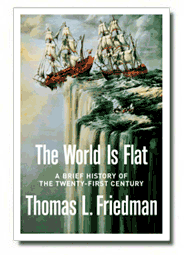
This blog is based on the book, The World is Flat, written by Thomas L. Friedman. I’m going to write on his ideas and what it means for people like me; young college going students of India.
The first question I had when I came across this topic was pretty obvious. What does someone mean by, “The World is flat”. I still remember my first grade teacher showing us a globe. She wouldn’t have been bluffing, would she? So that’s how Mr. Friedman hooked me to read the book. I read it because the title made me curious.

The world is flat, as Friedman explains, because “Globalization today empowers, enables and enjoins individuals and small groups to go global so easily and seamlessly”. Thing about it! How many things can you do today, which only major corporations could do a decade or so ago? Building a website, sharing information through voice and text with millions, interacting and communicating across the world are some. You can do all this today because they are essentially free, thanks to the internet. The playing field has been leveled and the global world; flattened.


One of the few new effects of this is outsourcing. India has benefited tremendously from this courtesy the new jobs flowing in. It doesn’t end here. Remember I said in the previous paragraph how individuals are being empowered. This has led to dynamic new ideas and innovations being born and put into business. On both worlds, both new and old (America and Eurasia) individuals are cutting into the growing pie of the global economy.

Friedman’s book fails to mention a recession because it occurred much later. No matter. The recession is a bump, a speed breaker to check the progress we are so rapidly making. The zenith of IT for example was after the DOT COM bubble (more info) burst.


The point that is coming to a clear focus is this. In the new age, there will be two ways to succeed. A mass of people mostly in the developing nations will start doing the work the developed nations had assigned to their workforce. These people will start working for a better standard of life. The other way will be occupied by those in the developed economies,(or even quick growers in the developing sphere) who learn to be more than a professional. They would require being great adapters, explainers, collaborators, leveragers, passionate and good networkers. They will need to create new ideas and make them marketable or offer something that makes them indispensable to a global supply chain. They have the power to do this, thanks to the internet.


Right now no one is completely certain where the developed world is heading next. We are at the brink of a revolution in industry and business, akin to the industrial revolution. Remember all those workers who were left jobless when the machines came to work? That’s kind of where we are right now. The workers starved initially and then as they accepted the machines, they changed their skill set to become operators. In the economic boom that followed, new companies bought more machines, needed more workers and prosperity ensued.

This is what we should be heading for. A world where an individual will have the power to affect his economic destiny; through collaboration with others like him.