Showing posts with label IT. Show all posts

Monday, July 26, 2010

A Thought Experiment


Cash Free society. 

Consider the Cell phone. It is ubiquitous, at least in a 2nd world India. It’s a Swiss knife of the digital age. Maybe it can become your banker too? I have thought about it and I have come to wonder why can we not let that happen.  Nowadays when I want to recharge my phone, I simply go to a recharge shop where a phone using his phone transfers funds into mine. Why can we not use this process in just a common a way? Say between a taxi driver and me.  
You can go to the nearby mobile service provider office and offer 105$ to get a credit of 100$.  This can be spent to different people by merely sending data messages from the customer’s cell phone to that of any service provider. Then when you wish to withdraw your money, you can go back to the office of the mobile service provider and make a withdrawal; just like any bank. 

The market potential of this idea is tremendous. The company to first develop this into a working reality will hold network monopoly curtsy an unrivalled product. There will be a quick shift in customer base and loyalties. Eventually companies will have to agree to let the product be used between two different networks.  By then however, the “Original Operators of the cashless program” would have made their fortune.
We would have achieved a truly cashless society, the only downside being: a more lucrative market for mobile phone robbery.

Tuesday, June 22, 2010

Getting around on a flat world


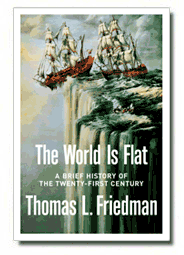
This blog is based on the book, The World is Flat, written by Thomas L. Friedman. I’m going to write on his ideas and what it means for people like me; young college going students of India.
The first question I had when I came across this topic was pretty obvious. What does someone mean by, “The World is flat”. I still remember my first grade teacher showing us a globe. She wouldn’t have been bluffing, would she? So that’s how Mr. Friedman hooked me to read the book. I read it because the title made me curious.

The world is flat, as Friedman explains, because “Globalization today empowers, enables and enjoins individuals and small groups to go global so easily and seamlessly”. Thing about it! How many things can you do today, which only major corporations could do a decade or so ago? Building a website, sharing information through voice and text with millions, interacting and communicating across the world are some. You can do all this today because they are essentially free, thanks to the internet. The playing field has been leveled and the global world; flattened.


One of the few new effects of this is outsourcing. India has benefited tremendously from this courtesy the new jobs flowing in. It doesn’t end here. Remember I said in the previous paragraph how individuals are being empowered. This has led to dynamic new ideas and innovations being born and put into business. On both worlds, both new and old (America and Eurasia) individuals are cutting into the growing pie of the global economy.

Friedman’s book fails to mention a recession because it occurred much later. No matter. The recession is a bump, a speed breaker to check the progress we are so rapidly making. The zenith of IT for example was after the DOT COM bubble (more info) burst.


The point that is coming to a clear focus is this. In the new age, there will be two ways to succeed. A mass of people mostly in the developing nations will start doing the work the developed nations had assigned to their workforce. These people will start working for a better standard of life. The other way will be occupied by those in the developed economies,(or even quick growers in the developing sphere) who learn to be more than a professional. They would require being great adapters, explainers, collaborators, leveragers, passionate and good networkers. They will need to create new ideas and make them marketable or offer something that makes them indispensable to a global supply chain. They have the power to do this, thanks to the internet.


Right now no one is completely certain where the developed world is heading next. We are at the brink of a revolution in industry and business, akin to the industrial revolution. Remember all those workers who were left jobless when the machines came to work? That’s kind of where we are right now. The workers starved initially and then as they accepted the machines, they changed their skill set to become operators. In the economic boom that followed, new companies bought more machines, needed more workers and prosperity ensued.

This is what we should be heading for. A world where an individual will have the power to affect his economic destiny; through collaboration with others like him.


Friday, May 28, 2010

Information beyond IT


How valuable is Information?

Information is power. The IT industry for example is one of the prime reasons why India can claim to be a fast growing global economic power. Yet the lack of proper dissemination of this information can lead to great loss and waste of resources. Take the town of Pondicherry, where I grew up as a kid. Many of my friends there are persevering and successful students. Yet they will not leave their town because of their prejudiced ideas of what lies outside. This inhibition is a barrier to their progress. Looking around I realize how ubiquitous this problem really is.

A large number of students choose to become engineers and doctors. Partly thanks to the IT success there seems to be no shortage of people willing to choose the former career. India does however have a shortage of nearly ten million workers in teaching, medical and allied fields. We have a shortage of trained and experienced faculty to teach the budding engineers. We have a shortage of nurses to protect us from the rising health risks. We have a shortage of scientists, researchers to further development. We have few capable administrators to run this country. The opportunities available in these fields do not make it through to the masses drowned in the race to become engineers and the lucrative offers of the IT industry.
If even a small percentage of these bright people could choose careers beyond the precedent fields then they would register a phenomenal change on the country.

Getting this to happen will not be easy in a nation as massive as India. The government alone cannot take all the necessary steps. Firstly the concept of choice should be made clear to the people. That is, one need not choose between merely two professions to succeed in life. There are whole arrays of careers just waiting to be explored. As people we need to cast off the suspicions and nervousness that envelopes career choice. We need to widen our minds and guess how we do that? By getting and spreading more information! And so the cycle continues.

I strongly believe that as long as humanity remains a dynamic species there will be no break from this cycle. In the second world the absence of this cycle in certain areas is a sign of stagnation or hangover from the third world experiences. I strongly believe in the intellectual vitality of the people of India. As the scars of past sufferings slowly heal away we will build a new society with broader mindsets and ensure better information is available to the people. That is how we will grow.